
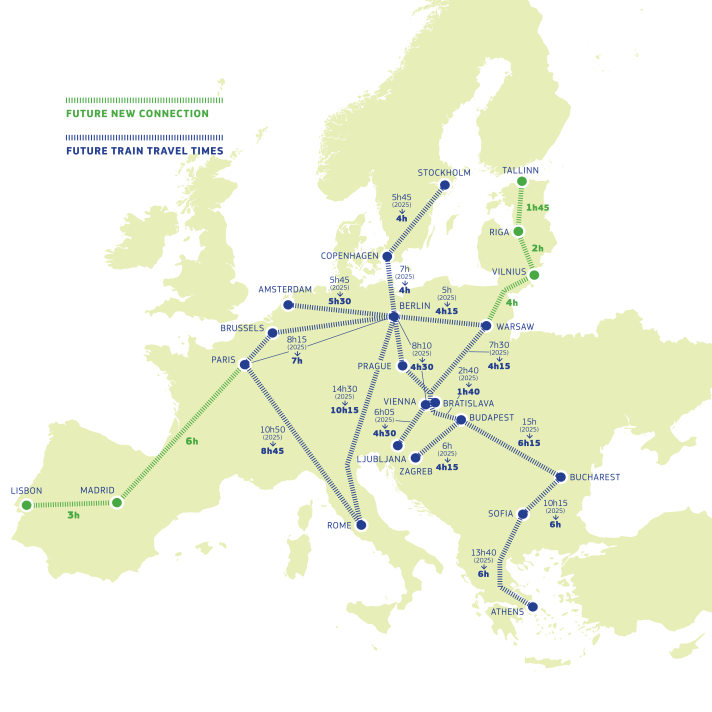
The European Commission is unveiling a comprehensive plan to accelerate the development of high-speed rail across the EU, offering passengers significantly reduced travel times. By boosting fast, comfortable, safe and reliable rail services, the plan supports the EU’s twin goals of becoming carbon-neutral by 2050 and strengthening Europe’s global competitiveness.
By 2035, Sofia and Athens will be just six hours apart by rail, while new cross-border connections will link the Baltic countries and enable passengers to travel from Paris to Lisbon via Madrid.
Why this matters ?
Connectivity & hub potential
Thessaloníki’s position on major TEN-T corridors means upgraded rail links can turn it into a multimodal gateway connecting the Balkans, Central Europe and the Mediterranean.
Sustainable logistics transformation
The shift to high-speed and high-quality rail supports modal shift (road → rail), helping Greece compete in green freight and meet EU sustainability goals.
Growth for the region
Improved infrastructure unlocks investment, logistics parks, intermodal terminals and jobs — positioning Greece & Northern Greece as a strategic node in Europe’s supply chain.
Next steps
Stakeholders should align with TEN-T corridors, target EU funding for rail upgrades, and collaborate regionally to foster a green, efficient logistics ecosystem.
Commissioner for Sustainable Transport and Tourism, Apostolos Tzitzikostas, stated:
“High-speed rail is not just about cutting travel times – it is about uniting Europeans, strengthening our economy, and leading the global race for sustainable transport. With today’s plan, we are turning ambition into action: breaking down barriers, mobilising investments for modern infrastructure, and making cross-border rail the backbone of a carbon-neutral, competitive, and secure Europe. Citizens across the Union will benefit from faster, safer, and more affordable journeys that bring Europe closer together.”
https://transport.ec.europa.eu
